
🦷 Every Month Is Dental Month at CoroVets
- 12 hours ago
- 5 min read
You know it's August when you see Dental Month and Discounts promos on your Facebook feed.
And while we’re all for giving pets’ teeth a little extra attention, here at CoroVets, we believe every month is dental month.
Why? Because the pain associated with dental disease doesn't exist for one month of the year.
🎉 The Good News…
Starting this August, we’re making dental care a little more rewarding. Each month, one lucky pet owner will win back the cost of their Stage 1 dental procedure.
Because we believe dental care deserves attention all year round, we're launching our CoroVets Monthly Dental Draw.
For Stage 1 dental procedures booked and completed within two months of receiving your dental booking-link email, you'll automatically be entered into our monthly draw.
Each month, one eligible dental procedure will be selected and the full cost of that procedure will be credited back to the owner.
So, while there's never a guarantee you'll be the lucky winner, getting started with your pet's dental health could potentially mean getting the entire cost of their procedure back as a credit.
There is one small catch: eligible winners must be happy for us to share a photograph of their winning patient on our social media pages.
Terms and conditions apply - see below.
Now, let’s talk about why your pet’s teeth deserve more attention than they often get.

🐾 The Dental Disease You Can't See
Dental disease is one of the most common health problems we see in dogs and cats and unfortunately, our pets are remarkably good at hiding it.
A dog with a painful tooth may still happily eat dinner. A cat with significant dental disease may continue to behave completely normally.
That doesn’t necessarily mean their mouth is healthy.
Pain, inflammation, periodontal disease, fractured teeth and infection can all develop beneath the gumline, where they simply can't be seen during a quick look at home.
By the time you notice signs such as persistent bad breath, dropping food or difficulty chewing, there may already be significant disease present.
That’s why a veterinary dental assessment is so important.
[Find out more about veterinary dentistry →]
🔎 What Actually Happens During a Dental?
A thorough veterinary dental procedure is about much more than simply removing visible tartar.
Once your pet is under anaesthesia, we can properly examine the entire mouth and assess each individual tooth. This allows us to identify problems that may otherwise remain hidden.
A comprehensive dental procedure includes:
A detailed oral examination and dental charting
Scaling above and below the gumline
Polishing to help slow future plaque accumulation
Dental radiographs to assess the roots and structures beneath the gumline
Assessment of every individual tooth
Treatment or extraction of painful or diseased teeth where required
Appropriate pain relief and local nerve blocks when extractions are necessary
Dental radiographs are particularly important in cats, where conditions such as tooth resorption can be painful yet invisible above the gumline. See more info on why cats are different here.

Dogs aren't off the hook either. Periodontal disease, fractured teeth and infection can all be more extensive than they initially appear, and sometimes we can't fully appreciate what is happening until the mouth has been cleaned and examined properly.
🦷 When One Dental Isn't Enough
Sometimes we start a dental procedure expecting a relatively straightforward job and discover considerably more disease than anticipated.
This is where staged dentistry comes in.
Rather than trying to complete extensive treatment during one very long anaesthetic, we may recommend dividing treatment into two shorter procedures.
Importantly, staged dentistry doesn't mean doing less dentistry.
It means giving us the opportunity to do better dentistry, more safely and more thoroughly.
Why stage dental treatment?
🌿 Healthier gums between procedures
Treating the first stage of disease allows inflammation and infection to settle before the remaining treatment is completed.
⏱️ Shorter, more manageable anaesthetics
Extensive dental procedures can take time. Dividing treatment helps avoid unnecessarily prolonged anaesthesia.
🔍 Better assessment and planning
Dental disease often reveals itself once the mouth has been cleaned and radiographed. What we discover during the first procedure can help us plan the second much more accurately.
💬 Fewer surprises
Staging gives us more opportunity to communicate what we've found, what treatment is needed and what to expect next.
🎯 No rushing important details
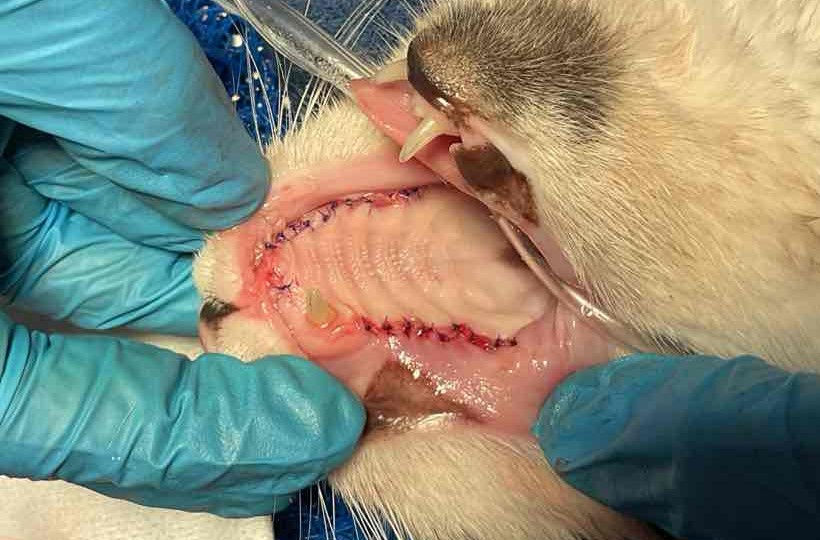
Good dentistry requires time and attention. Radiographs, charting, extractions and suturing shouldn't be rushed simply because we're trying to finish everything in one session.
👩⚕️ Better care for every patient
An unexpectedly long procedure can have flow-on effects for the rest of the day. Keeping procedures manageable allows our team to maintain the time and attention needed for every patient.
💪 Less staff fatigue
Dentistry is detailed and physically demanding work. Breaking extensive treatment into manageable stages helps our team maintain the highest standard of care throughout the day.
Two procedures. One goal.
The goal of staged dentistry isn't to make treatment longer for the sake of it.
It's to make sure your pet receives the safest, most thorough treatment we can provide, without unnecessarily prolonging anaesthesia or compromising attention to detail.
Sometimes, two carefully planned procedures are simply better than one very long one.
👀 Don't Wait for Your Pet to Tell You Their Mouth Hurts
Pets aren't particularly good at telling us when something is wrong, and dental pain is no exception.
Keep an eye out for:
Persisting bad breath
Red, swollen or bleeding gums
Dropping food
Chewing on one side
Changes in eating habits
Difficulty picking up food
Excessive drooling
Pawing at the mouth
Loose or fractured teeth
Reluctance to have their face or mouth touched
Unusual chewing or crunching noises
But here's the important bit:
No obvious signs doesn't necessarily mean a healthy mouth.


Many pets with significant dental disease continue to eat, play and behave normally.
Regular veterinary dental assessments allow us to identify problems before they become obvious and potentially before they become more painful and complicated to treat.
🐶🐱 Every Month Is a Good Month for Better Dental Health
August might be Dental Month.
But your pet's teeth don't know that.
If your dog or cat is due for a dental assessment, don't wait for bad breath, a broken tooth or difficulty eating to be the reason you book.
Talk to our team about your pet's dental health and whether a dental assessment is due.
And if treatment is needed, we'll work with you to develop a safe, thorough and realistic treatment plan, including staged dentistry where appropriate.
Because a healthy mouth isn't just about a nicer smile; it's about comfort, health and quality of life.
🦷 Stage 1 Dental Promotion - Terms & Conditions
The promotion starts in August 2026.
The promotion is applicable to Stage 1 dental procedures that are booked and completed within two months (60 days) of receiving the dental booking-link email.
Eligible procedures are automatically entered into the monthly dental draw.
One eligible procedure is selected each month to receive a credit equal to the full cost of that procedure.
The credit applies to the eligible dental procedure and is refundable.
The winner each month will be announced on our social media pages.
To be eligible to win, you agree to allow CoroVets to share photographs of your winning patient on CoroVets' social media pages.
CoroVets reserves the right to cancel the promotion at any time.


Comments